What happens on each move?
All tiles slide as far as possible in the chosen direction. Two equal tiles that meet combine into one tile with double the value. A tile merges only once per move, and a new tile appears after a move changes the board.
Slide the whole board. Equal numbers meet, double, and make room for the next move.
Two equal tiles combine into a larger one and create room for the next move.
Good to know: The game can continue beyond the 2048 milestone.
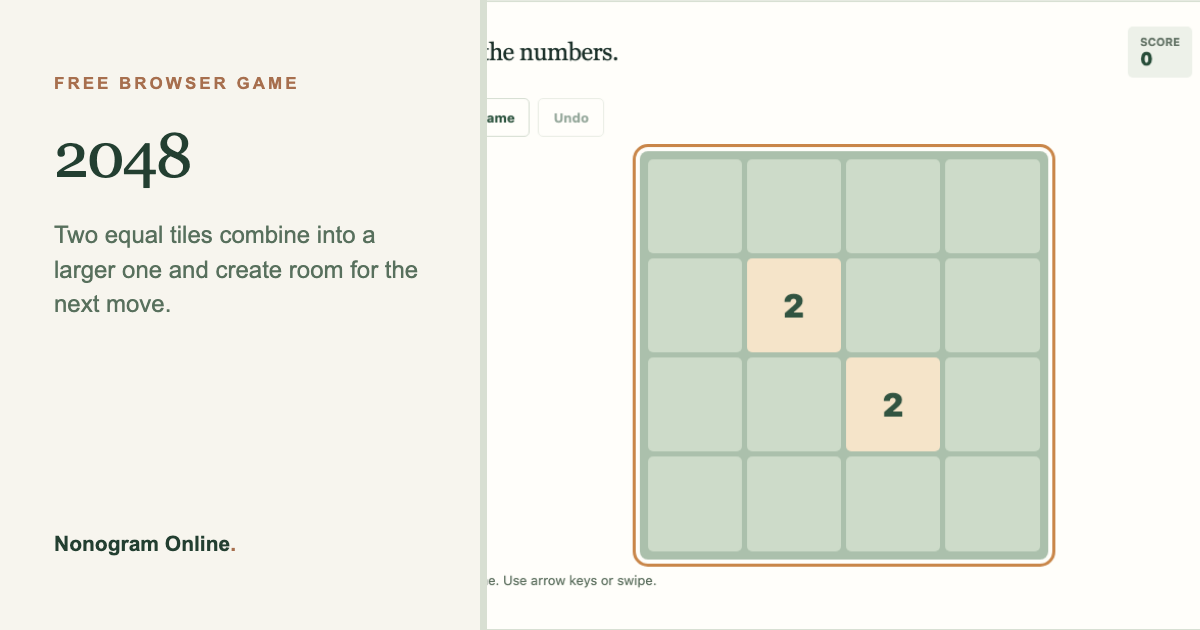
This 2048 number-merging puzzle slides every tile on a 4×4 board at once. Pair equal numbers and manage empty cells to reach the 2048 tile and beyond.
All tiles slide as far as possible in the chosen direction. Two equal tiles that meet combine into one tile with double the value. A tile merges only once per move, and a new tile appears after a move changes the board.
Yes. Reaching 2048 is a milestone, not a forced stop. Continue making larger tiles until no legal move remains, or start a fresh board whenever you want.
Slide a row of 2, 2, 2, 2 to the left and it becomes 4, 4, empty, empty before the new tile appears. The two new 4 tiles do not combine again in that same move.
Sliding left when every tile is already against the left edge and no equal neighbors can meet leaves the board unchanged. A new tile appears only after a move changes the board.
A swipe moves the entire board. Plan the resulting rows or columns, not just the pair you want to merge. A successful merge creates space, but a new tile appears afterward, so empty cells remain valuable.
Ignore gaps temporarily and read the tiles in movement order. Equal adjacent values combine once; the result cannot merge again in the same move.
A corner is a useful home for the largest tile if nearby tiles can feed into it. It is a strategy, not a rule that makes every corner-preserving move good.
Prefer a board with room to slide and accessible matching pairs. A quick score increase can be costly if it separates a large tile from every useful partner.
This is an illustrative row; the other rows are omitted. Results below show the row before the random new tile appears.
Before: 2  2  2  2
Left:   4  4  ·  ·
Not:    8  ·  ·  ·
A direction that changes nothing does not spawn a tile. You need movement or a merge.
Sometimes a different direction is necessary to keep moves available. Judge the resulting board, not a rigid rule.
Predict one complete row before each swipe. Use Undo to inspect the previous decision if needed; do not assume another attempt will produce the same random spawn.
Return to the game and practise ↗