What makes a number valid?
Each row, column, and 3×3 box must contain the digits 1 through 9 exactly once. Given digits cannot be changed. Pencil mode stores temporary candidates in an empty square without committing a final value.
Nine rows, nine columns, nine boxes. Give every empty square its one correct number.
Each certain digit narrows the remaining possibilities.
Good to know: Published puzzles have one solution, and entries are saved on this device.
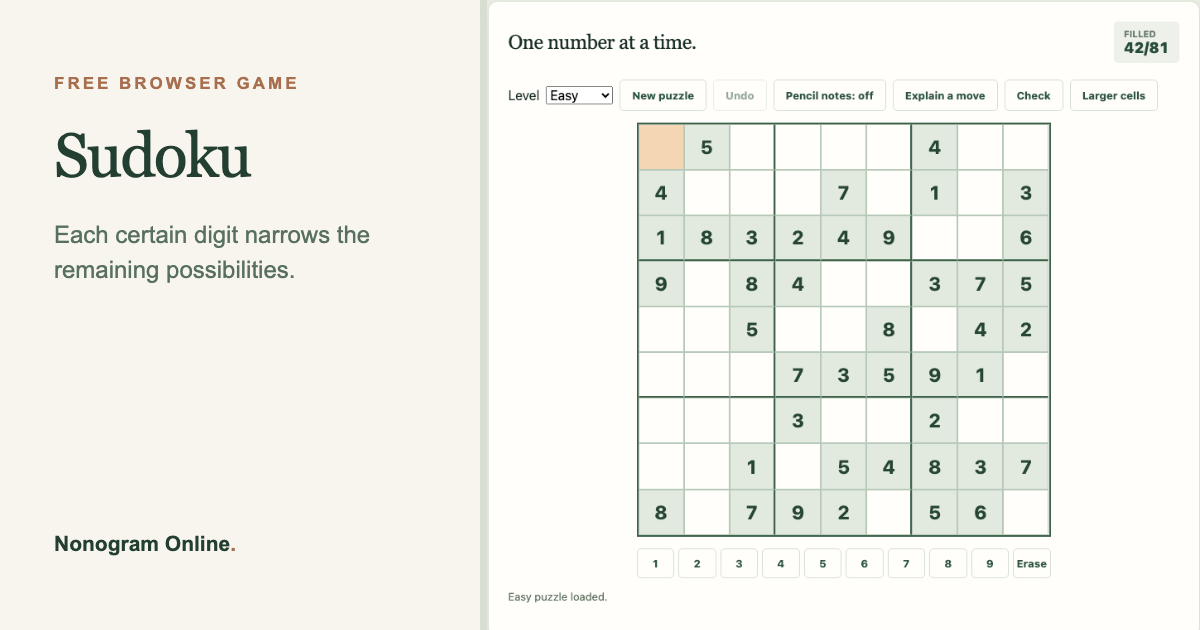
Solve a 9×9 Sudoku online using row, column, and 3×3 box constraints. Pencil notes hold possibilities until you can place a final digit.
Each row, column, and 3×3 box must contain the digits 1 through 9 exactly once. Given digits cannot be changed. Pencil mode stores temporary candidates in an empty square without committing a final value.
Choose Easy, Medium, or Hard, then press New puzzle. Each published puzzle has been checked for a single solution. Your entries and pencil notes are saved on this device.
If a row is missing 4 and 7, check the empty squares against their columns and 3×3 boxes. If one square already shares a column with 7, it must be 4.
Writing 4 and 7 as candidates does not place either digit. Choose the final number only after the row, column, and box rules rule out the other option.
A digit must fit three constraints at once: its row, column and 3×3 box. Pencil notes record possibilities; they are not proof that a digit belongs there. The reason for placement is what excludes the alternatives.
For a nearly complete row, list what is absent. Then check each empty square’s column and box to reduce that list.
A square may have only one candidate, or a digit may have only one possible square within a row, column or box. Both are useful forced singles.
A filled digit affects all three connected units. Recheck nearby pencil notes yourself; a note is something you entered, not a promise that it is still valid.
Illustrative position: a row is missing 4 and 7, with two empty squares A and B. A’s column already contains a 7. Assume the remaining row, column and box constraints permit the resulting placements.
An incorrect entry can avoid an immediate duplicate. Check compares entries with the published solution; ordinary conflict highlighting alone is not a proof.
Explain a move looks for forced singles and may ask you to correct earlier entries. If no single is available, examine candidates instead of assuming an arbitrary digit.
Start with Easy. Before placing a digit, state either “this square has no other candidate” or “this digit has no other square in this unit,” and identify the constraints that make it true.
Return to the game and practise ↗