In Block Hop, a short landing calls for a longer charge; an overshoot calls for an earlier release. Make that adjustment on the same target before comparing different jumps. After a miss, Retry this jump · practice restores the starting object and target so you can change one thing at a time.
This guide applies to our browser version of Block Hop. Other hold-to-jump games may use different timing, scoring, or collision rules.
Read the landing before changing the charge
The game tells you whether you were too short or too far. Use that direction first. A miss by a small distance calls for a small correction; swinging from a very brief hold to a very long hold makes it harder to learn where the safe interval lies.
These are real captures of the same first target with different charges, followed by the practice state. They illustrate the result of the controls, not a promise that one duration works for every object.

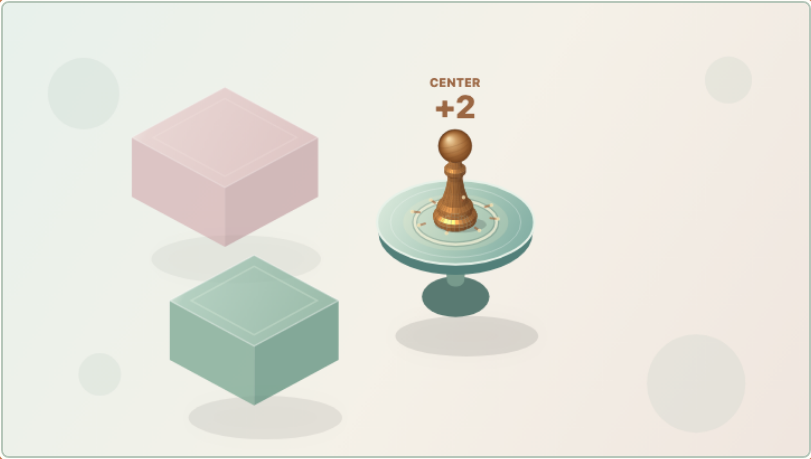
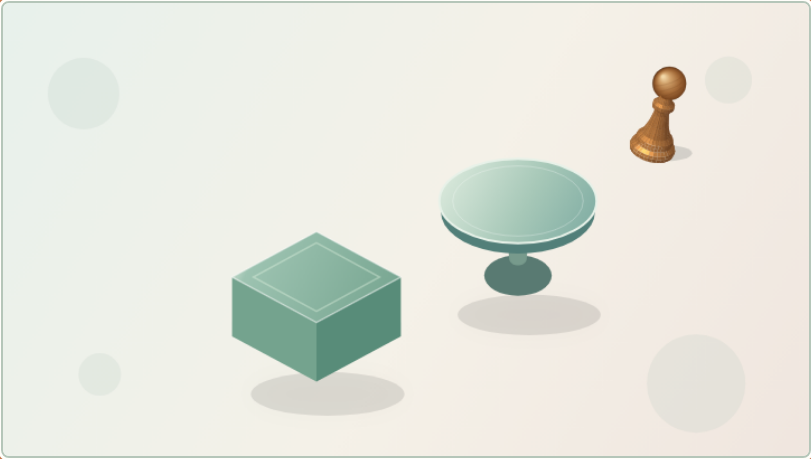
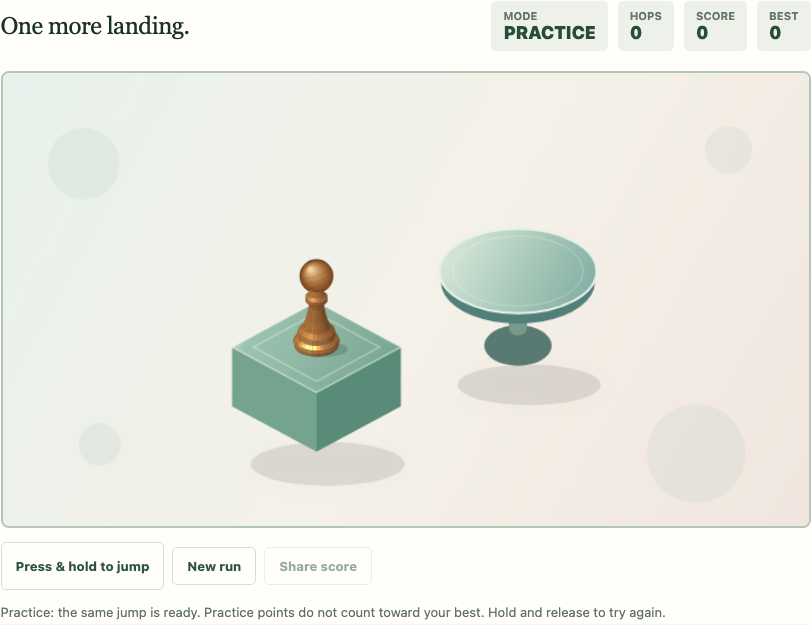
A centered landing is useful feedback, but an ordinary safe landing also progresses the run. First learn to reach the object consistently. Then narrow your timing toward its center.
Why timing changes distance
Holding charges the jump; releasing launches it. In this version, distance increases linearly with charge until the one-second cap. Holding beyond that cap does not send the pawn farther.
The opening target is 200 game units from the starting position. The distance rule is 65 + 0.3 × charge in milliseconds, capped at 1,000 milliseconds. A 450 ms charge therefore travels 200 units and reaches the opening target's center in the game's model.
That number explains the mechanism. It is not a stopwatch task for your fingers, and game units are not screen pixels. Input timing and the camera view can make a hand-timed attempt differ from the calculation. Later target distances, widths, and your takeoff position also change. Read the target and the result rather than repeating 450 ms on every jump.
Use practice to bracket a safe landing
After a miss, wait for the round-over message and choose Retry this jump · practice. Check that MODE reads PRACTICE. The same starting object and target return, and the pawn resets to the starting object's center. If the failed attempt began off-center, its takeoff position was different: use the first practice attempt to recalibrate before comparing holds.
Try this routine:
- Repeat the failed jump with a small correction in the indicated direction.
- If you were short and are now long, your two attempts bracket a useful range. Aim between those holds.
- If both attempts are short, lengthen again gradually. If both are long, shorten gradually.
- Once you land, notice whether you were near an edge or near the center before moving to the next target.
Practice continues to the next target after a successful landing; it does not freeze one target forever. You can retry a new miss in practice. Use New run when you want to return to a scored run. Practice points do not update your saved best, and score sharing is disabled in practice.
Understand why an edge touch can still fail
Seeing the pawn touch an object is not the same as making a safe landing. The game leaves an eight-unit margin inside each edge. Landing outside that safe area earns no points, even if the animation briefly catches the edge before falling.
A centered takeoff and an off-center takeoff also leave different distances to the next target. Think about the pawn's current position, not just the gap between the objects.
Smaller precision targets can begin appearing after five successful landings. Their narrower safe area makes small timing errors matter more. A timing habit that survived a wide table may miss a small cylinder, even when the visual gap looks similar.
Build a center streak without chasing every bonus
An ordinary safe landing earns one point. The first center landing earns two. Consecutive center landings earn four, six, eight, and so on, up to 32 points per center landing. An ordinary landing resets that center streak.
The center zone has a maximum radius of 14 game units, reduced for narrow objects. Wider objects therefore offer more room for a safe landing, but do not give you an unlimited center-scoring area.
When a new target is narrow or unfamiliar, staying on the object is a useful practice goal. Once your misses become small and predictable, work on centering. This is a training suggestion, not a guaranteed high-score strategy.
A short practice session with a clear goal
Start Block Hop and concentrate on the opening target. If you miss, name the error before retrying: short, long, or an unsafe edge landing. Make one deliberate timing adjustment.
Your goal is to explain why the next attempt improved or got worse. Once you can do that reliably, carry the same feedback loop into later targets. Scores measure the run's outcome; a repeatable correction tells you what you are learning.