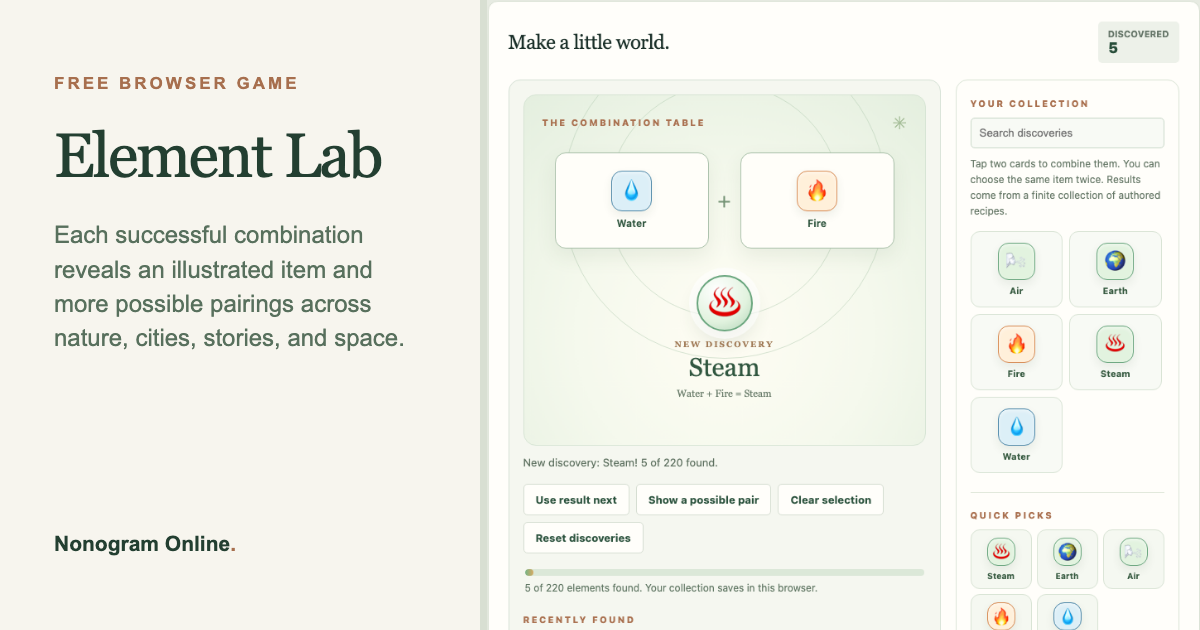
Start with four elements. Discover weather, living things, places, inventions and stories; each new item opens another path.
WHAT TO EXPECT
Is Element Lab your kind of game?
Each successful combination reveals an illustrated item and more possible pairings across nature, cities, stories, and space.
Good for
Curious, unhurried exploration
One session
Discover recipes at your own pace from a finite authored collection
Controls
Select one discovered item, then another to try a pair
What you use
Explore playful associations between items; the recipes are game rules, not science facts.
Good to know: Results are stable and repeatable. This is not an infinite AI crafting game.
Preview of the playable Element Lab game above.RULES & EXAMPLES
How element combinations work here.
Element Lab is an illustrated element combination game built from four starting items and a finite collection of authored crafting recipes. Follow branches through nature, cities, stories, and space by trying two discovered items together.
What can I combine?
Any two items in your collection can be tried, including two copies of the same item. A known recipe creates a result and adds it to your collection. Unsuccessful pairs do not remove either item. Use the search field as your collection grows.
Is this an infinite AI crafting game?
No. Element Lab has an authored set of recipes so every result is stable and repeatable. The hint button shows one available path to a discovery you have not made yet.
A recipe that works
Select Water and then Fire. The authored recipe creates Steam and adds it to your collection, so you can try Steam in another pair.
A pair without a recipe
Water plus Water does not create a new item in this collection. An unsuccessful pair leaves both elements available; try another combination or ask for a possible pair.
UNDERSTAND THE NEXT MOVE
Explore recipes with a repeatable search method
Element Lab rewards associations, but its recipes are fixed. A failed pair does not mean you were too slow or need to wait: that pair has no recipe in this collection. The items remain available.
How to decide
Explore one branch at a time
Combine two known items, then use the result with a starter to explore a related branch. This gives each attempt a purpose instead of repeatedly choosing random cards.
Keep track of unsuccessful ideas
The order of a pair does not change its recipe. Retrying Fire + Water as Water + Fire will not uncover a different result.
Use a hint to learn a connection
Show a possible pair identifies a recipe whose ingredients you have and whose result you have not discovered. Think about the association, then try a related pairing yourself.
WORKED EXAMPLE
From a known pair to a new line of exploration
Begin with the four starter items. This example uses a recipe in the current collection.
Water + Fire → Steam
Water + Water → no recipe
Select Water, then Fire
Steam is added to your discovered collection. Water and Fire are not consumed.
Choose Use result next
Steam becomes the starting point for your next attempted pair. You still need to choose a second known item.
If a later pair fails
Clear or change the selection and try another idea. A failed recipe does not undo Steam or remove either ingredient.
Common mistakes and why they matter
Treating recipes as chemistry
These are playful authored associations. A result is a game rule, not a scientific claim.
Expecting an unlimited generator
The collection is finite. A message that every reachable recipe has been found refers to this collection, not every imaginable combination.
Try it yourself
Discover one new item, then try it with each starter once. Use search to find the cards, and use a hint only after you have tested that small set.