What are the tableau rules?
Move face-up cards between the seven columns in descending rank and alternating colors. An empty column accepts only a King or a sequence starting with a King. When a face-down card is uncovered, it turns face up.
The familiar card game: uncover the tableau, build alternating colors, and move every suit to its foundation.
Uncover face-down cards and build each suit from Ace to King.
Good to know: The stock draws one card at a time and may be recycled without a limit.
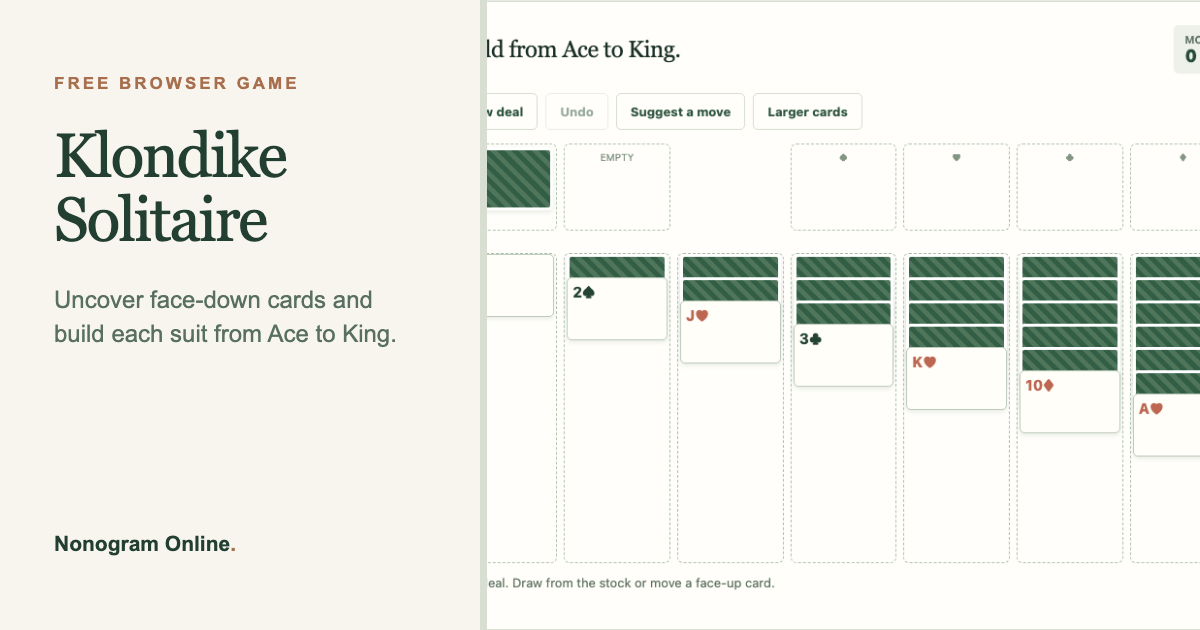
This turn-one Klondike Solitaire game draws one card at a time. Build the tableau in alternating colors and each foundation by suit from Ace to King.
Move face-up cards between the seven columns in descending rank and alternating colors. An empty column accepts only a King or a sequence starting with a King. When a face-down card is uncovered, it turns face up.
The stock turns over one card at a time. Tap its top waste card to select it, then tap a legal destination. Foundations begin with an Ace and rise by suit to King. You may recycle the stock without a limit in this version.
Place a red 7 on a black 8 to build downward in alternating colors. A newly uncovered face-down card then turns face up, giving you another move to consider.
A red 7 cannot go on a red 8, even though the ranks are consecutive. Only a King or a sequence beginning with a King can move into an empty tableau column.
A legal move is not always a useful move. In turn-one Klondike, uncovering a face-down card creates a new option; shuffling already exposed cards between columns may change very little.
Find a movable face-up run with a face-down card behind it. Check whether another column can accept the run’s leading card.
Only a King or a run starting with a King can fill an empty column. Clear a column with a useful King move in mind.
Foundations rise by suit, but the tableau descends in alternating colors. A card eligible for a foundation might still be a useful landing place for another tableau run.
Suppose a face-up red 7 followed by a black 6 sits above a face-down card. Another column ends in a face-up black 8.
Destination: black 8
Move run:    red 7 → black 6
Result:      black 8 → red 7 → black 6
A red 7 does not fit on a red 8. Tableau moves need both descending rank and alternating color.
Unlimited recycling does not itself create a new legal destination. Reassess tableau spaces and foundation needs when the same cards recur.
For one deal, explain the purpose of each move: uncover a card, open a King space, prepare a run, or build a foundation. A legal move without a purpose may be worth postponing.
Return to the game and practise ↗