In our browser version of Block Hop, an ordinary safe landing earns 1 point and resets the center streak. Consecutive center landings earn 2, 4, 6, 8… points, capped at 32 points per landing. A broken streak does not erase the points already earned.
Here is a complete seven-landing example: 2 + 4 + 6 + 1 + 2 + 4 + 6 = 25 points. The fourth jump is the important one. It succeeds, but it lands outside the center zone, so the fifth jump starts a new streak.
These rules describe Block Hop on Nonogram Online. They are not a scoring guide for every game with a similar name.
Watch the score and the hop count separately
This is one continuous recorded run with automated keyboard input and a repeatable target sequence. The game's collision checks and score updates are unchanged. The captions explain what happens; the run is not a human high-score claim or a benchmark for how quickly you should learn. The video is silent and includes English captions.
HOPS counts successful landings. SCORE adds the points from those landings. They match only when every landing earns one point. After seven landings in this example, HOPS reads 7 while SCORE reads 25.
Follow all seven landings
| Jump | Target | Landing | Points added | Total | Center streak |
|---|---|---|---|---|---|
| 1 | round table | Center | +2 | 2 | 1 |
| 2 | books | Center | +4 | 6 | 2 |
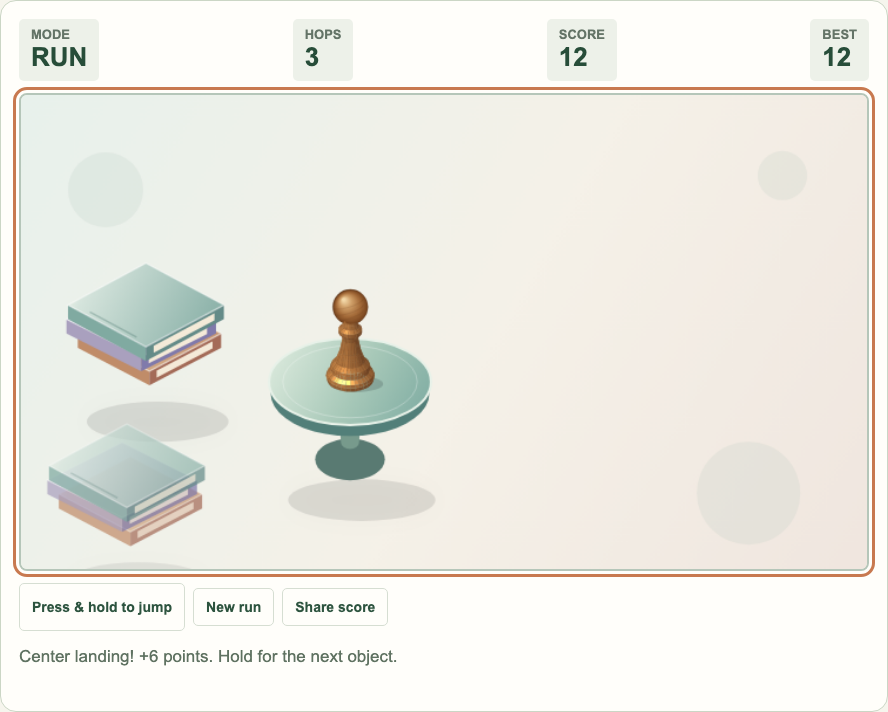
| 3 | round table | Center | +6 | 12 | 3 |
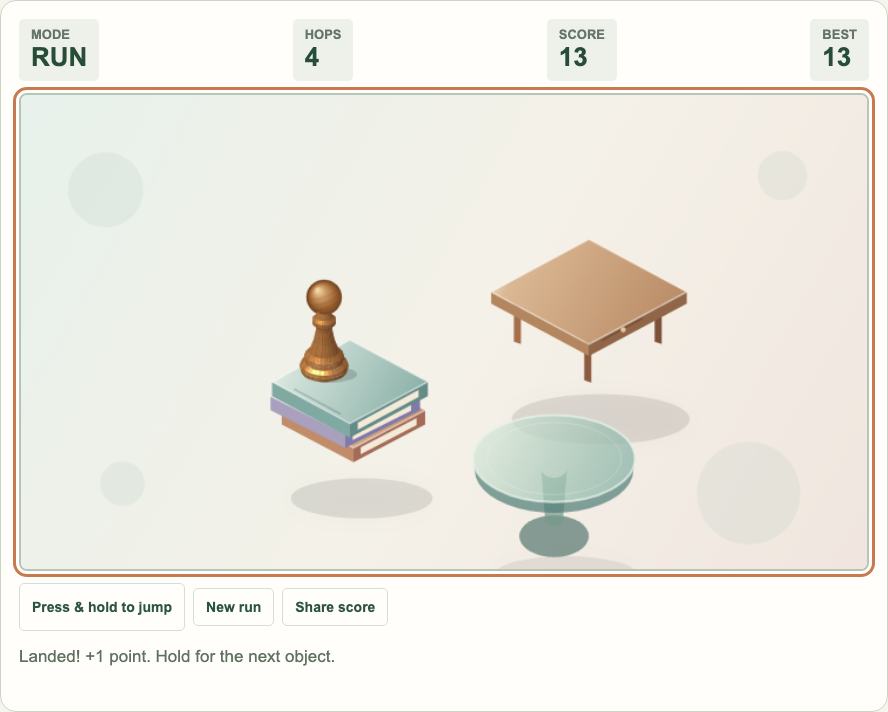
| 4 | books | Ordinary safe | +1 | 13 | 0 |
| 5 | desk | Center | +2 | 15 | 1 |
| 6 | mini table | Center | +4 | 19 | 2 |
| 7 | tissue box | Center | +6 | 25 | 3 |
The first three landings are centered. They add +2, +4 and +6, taking the score to 12. Notice that the third center landing is worth six points, not six times the previous reward.
The fourth landing is deliberately off-center but inside the safe part of the books. It adds +1 and takes the score to 13. That is a successful landing: there is no failure screen and the next object appears normally. However, the center streak is now zero.
The fifth jump lands in the center of a desk. It adds +2, not +8. The score becomes 15. The sixth and seventh centers add +4 and +6, bringing the final total to 25.
The distinction is useful when reviewing your own run. A small increase in score can mean you survived with an ordinary landing; it does not necessarily mean the game missed a successful jump.
Why the sixth target changes the decision
Small precision targets can start appearing after five successful landings. They are not guaranteed to appear on the sixth jump in every run. In this recorded sequence, the sixth target is a mini table.
The distance rule is unchanged. Holding still increases travel distance until the one-second cap. What changes is the tolerance: the eight-unit unsafe margin inside each edge takes up a larger proportion of a narrow target. The center bonus zone also shrinks on small objects.
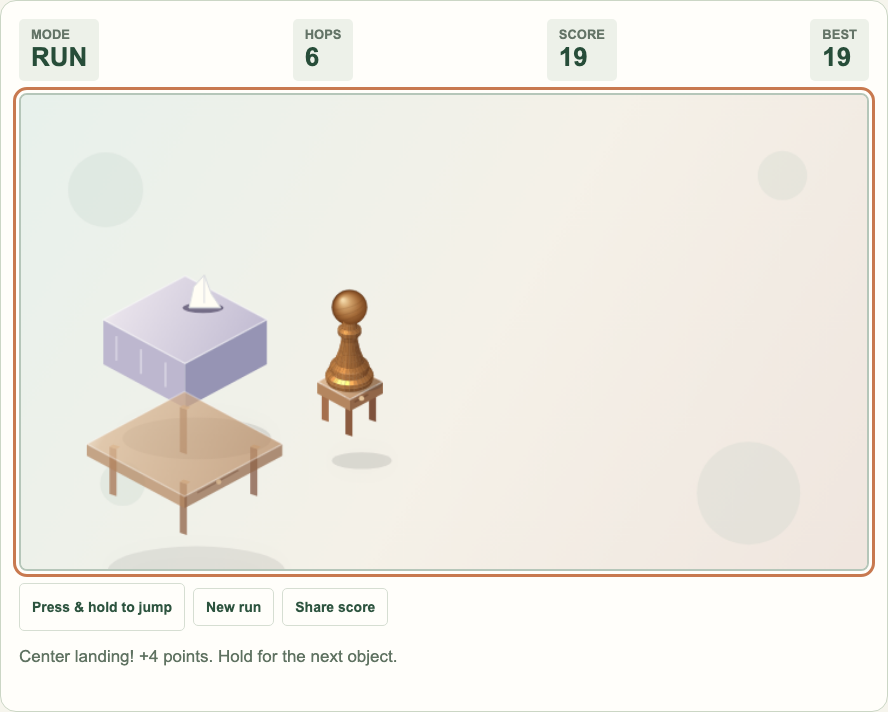
Aim at the target's center as a reference, but do not reuse a hold merely because it worked on the previous desk. Both the new target's position and your takeoff position matter. In this run, the ordinary fourth landing also leaves the pawn off-center on its starting object for jump five.
The recording shows a successful narrow landing; it does not establish that chasing every bonus is the best strategy for every player. Before thinking about the next reward, check whether you can reliably reach the safe area.
Read a miss before practising it
If a jump fails, wait for Retry this jump · practice. Practice restores the starting object and the missed target, with the pawn at the starting object's center. If your failed jump began off-center, that reset changes the travel distance: use the first practice attempt to recalibrate.
Practice resets the displayed score and hop count. Its points do not update your saved best, and score sharing is disabled. A successful practice landing advances to the next target. Choose New run to return to scored play; practice does not resume the old score.
Our jump timing guide demonstrates short, long and centered attempts on the same opening target, with a diagram of the safe and center zones.
A useful first challenge
Try a short exercise with two separate goals:
- In a new run, reach three objects. Count successful landings rather than aiming for an arbitrary high score.
- Read the score after each landing. Identify which landings added +1 and which added a center bonus.
- When you miss, name the direction before choosing practice: short, long, or an unsafe edge contact.
- Return to a new run after practising. See whether you can repeat the correction on a fresh sequence.
The seven-landing recording is an explanation, not a score you have to beat. A useful improvement is being able to explain why your fourth landing earned one point and why the next center restarted at two.
Play Block Hop, watch HOPS and SCORE separately, and use each landing as feedback for the next hold.