How do I time a jump?
Guan Guan can jump when her skateboard is on the ground. Press Space, the up arrow, or the on-screen button shortly before a cactus reaches her. Her speed rises with distance, and later stages add taller and paired cacti.
Guan Guan rolls across the desert on her skateboard. Time each leap over a cactus as the ride grows faster and obstacles change.
Help Guan Guan clear changing cacti as her skateboard ride speeds through five pace stages.
Good to know: Guan Guan is based on the site owner’s tabby cat. This original game is not affiliated with Google.
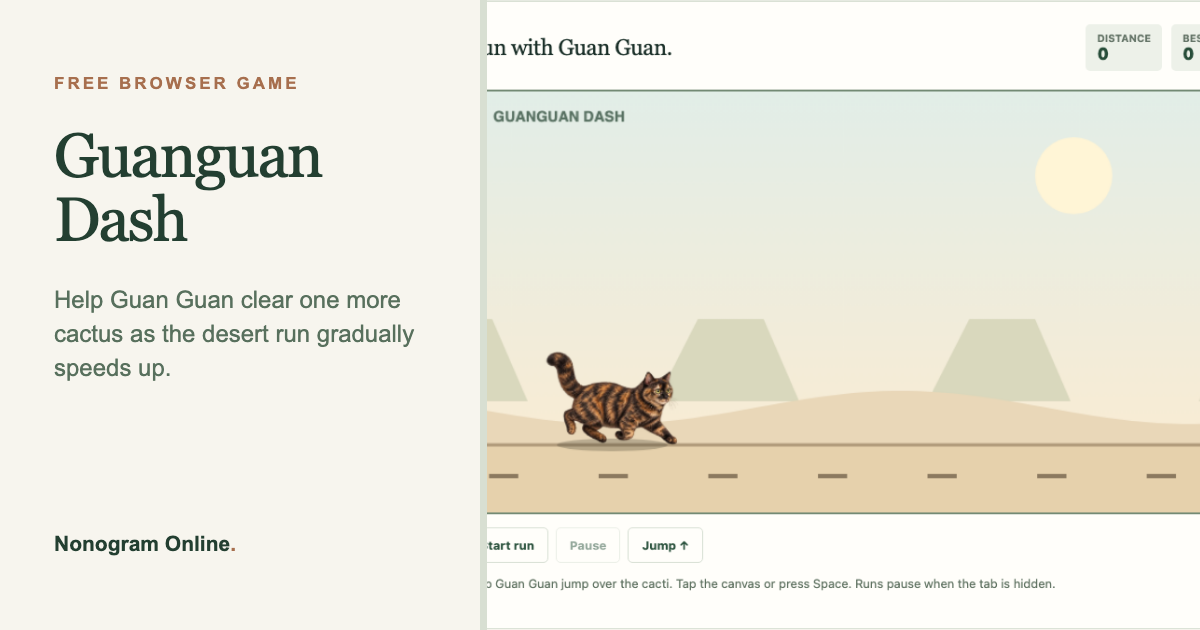
Guanguan Dash is a one-button cat skateboard runner. Help Guan Guan jump single, tall, and paired cacti while the pace rises with distance.
Guan Guan can jump when her skateboard is on the ground. Press Space, the up arrow, or the on-screen button shortly before a cactus reaches her. Her speed rises with distance, and later stages add taller and paired cacti.
No. Guanguan Dash is an independent skateboard runner starring Guan Guan, with its own artwork and name. It is not affiliated with Google.
In an early run, watch a single cactus approach and tap Jump shortly before it reaches Guan Guan. As the skateboard speeds up, react to the later tall and paired cacti sooner.
Jumping too early can put the skateboard back on the ground when the cactus arrives. The pace changes with distance, so the timing from the opening stage will not always work later.
Guan Guan jumps from the ground, then follows an arc back down. The whole obstacle must pass during that airborne window. Starting a jump as soon as you see a cactus can make you land on it.
A paired cactus occupies a longer stretch of the track than a single cactus. Judge when the skateboard will clear the far edge, not just its first edge.
At higher speed, the same visible gap disappears sooner. Adjust your trigger distance rather than repeating a fixed delay from an earlier run.
A jump requires the skateboard to be on the ground. Another press in midair does not add a second jump or extend the first.
Imagine two attempts at the same opening cactus, followed by a later, faster stage.
The next obstacle tells you when to act. Keep enough attention ahead to read its width and approach.
This does not create a double jump. Concentrate on the takeoff and landing window.
Use early runs to distinguish an early landing from a late takeoff. Change only the takeoff timing on the next attempt, then reassess when the pace changes.
Return to the game and practise ↗