How does flying work?
Every tap gives the bird a short upward push; gravity continues between taps. Aim for the middle of a gate and use smaller corrections as it approaches. A point is awarded after the bird passes a gate.
One tap lifts your bird. Gravity brings it down. Find the rhythm and thread each opening.
Find a steady rhythm and make it through one more gate.
Good to know: Flap Flight uses its own name and artwork; the best gate count is saved locally.
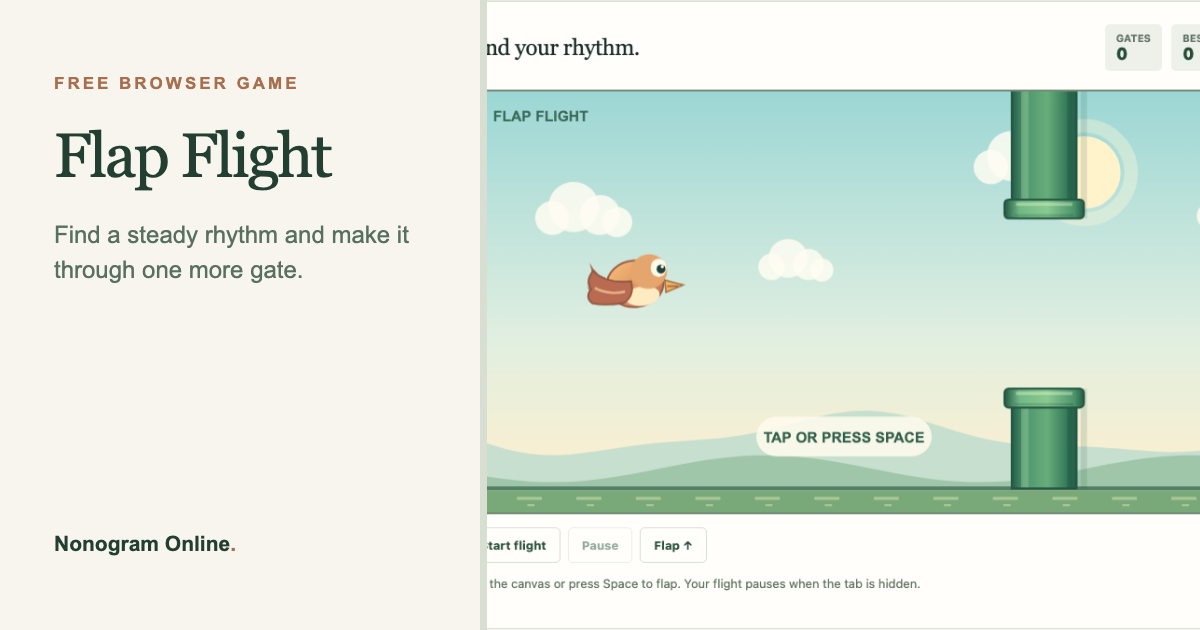
Flap Flight is a one-button bird game. Tap to rise, let gravity lower you, and time each flap to pass through the gaps between gates.
Every tap gives the bird a short upward push; gravity continues between taps. Aim for the middle of a gate and use smaller corrections as it approaches. A point is awarded after the bird passes a gate.
Touching a gate, the top of the sky, or the ground ends the flight. Press Start flight to try again; your best gate count is saved locally.
Aim for the middle of the opening. Tap to lift the bird, then let it settle before making another small correction as the gate approaches. The point arrives after you pass it.
A flap made too close to the top can send the bird into the ceiling. Falling below the opening hits the lower gate or ground; neither crossing earns a point.
A bird at the right height can still be on a bad path if it is dropping quickly. Each flap pushes upward while gravity continues between flaps. Judge both the bird’s position and its direction of travel.
Move toward the opening early enough to make a small final adjustment. A large correction beside the gate can send you into its upper edge.
After tapping, observe the rise before tapping again. Repeated taps can keep you climbing when you need to settle.
Aim around the middle of the opening, with room above and below for the remaining motion. Passing a gate means clearing it, not merely reaching its front edge.
The bird is near the opening’s center while descending. The gate is still approaching.
By then there may be too little space to recover from a fast fall.
Treat each input as an upward action. The aim is a controlled trajectory, not the largest number of taps.
Focus on whether each gate approach is rising or falling. Try to make one deliberate correction before the opening, then observe what happens.
Return to the game and practise ↗Finished your Flap Flight run? A nonogram has no time limit: fill cells from the row and column clues to reveal a picture.
Choose one of four small practice puzzles. Read the clue rules and follow a complete five-step example before playing.
Work through a larger picture with explained deductions and a diagram for every step. You can also play the same puzzle without revealing its answer.