A row that follows the clue
For a six-cell row with the clue 2, 3, fill cells 1 and 2, leave cell 3 empty, then fill cells 4, 5, and 6. Check the crossing columns before marking other rows.
Nonogram Online offers a free daily 10×10 nonogram and 5×5, 10×10, and 15×15 practice grids, with no download or account. Optional hints explain a clue-based deduction, and your progress is saved in this browser.
Play today's puzzle Free to play · No sign-up · Progress saved on this deviceRead the numbers. Fill the squares. Watch the picture appear.
Progress stays in this browser. A private window may clear it when closed.
Swipe sideways to see the full grid.
Each deduction uncovers more of a hidden picture; finishing gives you a clear stopping point.
Good to know: Optional hints explain a clue-based deduction. The timer counts elapsed time, not a countdown. Your progress stays in this browser. Copy a puzzle link to send the same daily or practice puzzle to a friend.
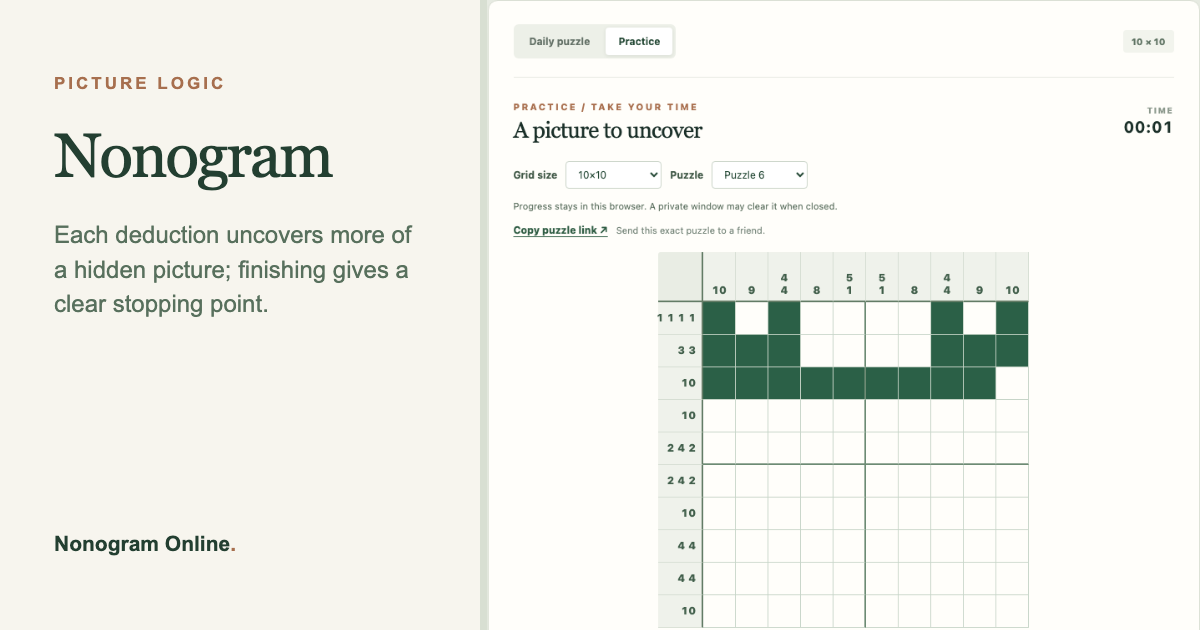
This free daily nonogram is a picture logic puzzle. The 10×10 daily grid and the practice grids use Picross-style row and column clues: fill each group in order and leave at least one blank square between groups.
For a six-cell row with the clue 2, 3, fill cells 1 and 2, leave cell 3 empty, then fill cells 4, 5, and 6. Check the crossing columns before marking other rows.
Five adjacent filled cells are not a valid answer to 2, 3 because the groups need a blank between them. Three filled cells followed by two also reverses the clue order.
The current library contains four 5×5, twenty-eight 10×10, and two 15×15 base pictures. The daily season uses the 28 ten-cell pictures with rotating orientations; dates may repeat a picture. Every published base puzzle is checked for a unique solution.
A hint marks one cell and explains the clue or full-grid consistency check that forces it. The clock measures elapsed time, with no countdown. Marks, elapsed time, and hint count are saved for the selected puzzle in this browser.
Copy puzzle link shares an exact practice puzzle or UTC daily date. Your friend's progress is separate from yours. A shared link identifies the puzzle; it does not transfer your marks or save data to another device.
In a 15-cell line, clue 15 fills the entire line. A single clue 13 overlaps in the middle 11 cells. For several groups, include at least one empty cell between them; fill only cells forced by every valid placement.
| Symbol or tool | Meaning |
|---|---|
| Filled / ■ | A square belonging to a clue's filled run. |
| Empty / × | A square you have determined must be blank; it is not an error marker. |
| Unmarked / · | A square whose state is still unknown. |
| 3, 1 | A run of three, at least one blank, then a run of one, in that order. |
| 0 | The whole row or column is empty. |
| Hint / Undo | Explain and mark a forced cell, or undo an earlier move. |
A clue describes a whole line, not the next square to click. Keep every placement that fits the clue and your confirmed marks. Only cells shared by all those placements are safe deductions. A plausible-looking picture is not evidence.
Add the run lengths and one separator between adjacent runs. In five cells, 3, 1 needs 3 + 1 + 1 = 5 cells, so the line must be ■■■×■. The separator is an empty cell, not another filled square.
For a single run of 5 in seven cells, try its leftmost and rightmost positions. Cells 3–5 overlap. Fill those three; cells 1, 2, 6 and 7 still need evidence from crossing clues.
A newly filled square constrains its column as well as its row. Revisit that crossing line. Mark a separator only when the run is known to be complete; an unfinished fragment may still extend.
This is a line example, independent of today’s puzzle. No squares have been marked yet. ■ is filled, × is empty in a proposed placement, and · is still unknown in your conclusion.
Start at 1   ■■■■■××
Start at 2   ×■■■■■×
Start at 3   ××■■■■■
Proven       ··■■■··
An unmarked cell means you have not decided. An × is a positive deduction that the cell is empty. Confusing the two can incorrectly eliminate the real solution.
A line may still have several placements even when the complete puzzle has one answer. Check other rows and columns before making an assumption.
Open a 5×5 practice puzzle. Before each move, say which clue forces it and what would fail if you made the opposite mark. Use Hint to compare the explanation with your reasoning, then try the same idea on a crossing line.
Return to the game and practise ↗Follow a complete 5×5 example · Inspect every step of the 15×15 solution
Learn how separate groups, required gaps, and overlapping placements determine a cell. The Nonogram rules and solving guide explains these techniques with examples.
Follow five deductions through a complete 5×5 puzzle, then open that exact puzzle to practise. Ready for a bigger example? Follow the complete 15×15 nonogram walkthrough. Prefer to solve it yourself first? Play the example puzzle before reading its solution.
Browse the daily puzzle archive with answers and full solutions, or in the game above, choose Daily and use Daily archive to select a date from September 29, 2026 onward. Copy puzzle link shares that exact date. The daily puzzle changes at 00:00 UTC; progress is stored separately for each date.
Nonograms are picture logic puzzles also known as Griddlers, Hanjie, or Paint by Numbers; Picross-style and Picture Cross games use the same row and column clue principle. Nonogram is the puzzle type; this site uses its own pictures and is not affiliated with other puzzle brands. Each number gives a filled run, and consecutive runs need at least one empty cell between them. Here, the picture is uncovered by deduction.
Nonogram Online uses its own finite puzzle collection. Published pictures are checked for a unique solution, and daily dates can reuse rotated or reflected pictures. Read our puzzle checks and game notes for the limits of the library.